 Live
LiveDuck Hunter HQ
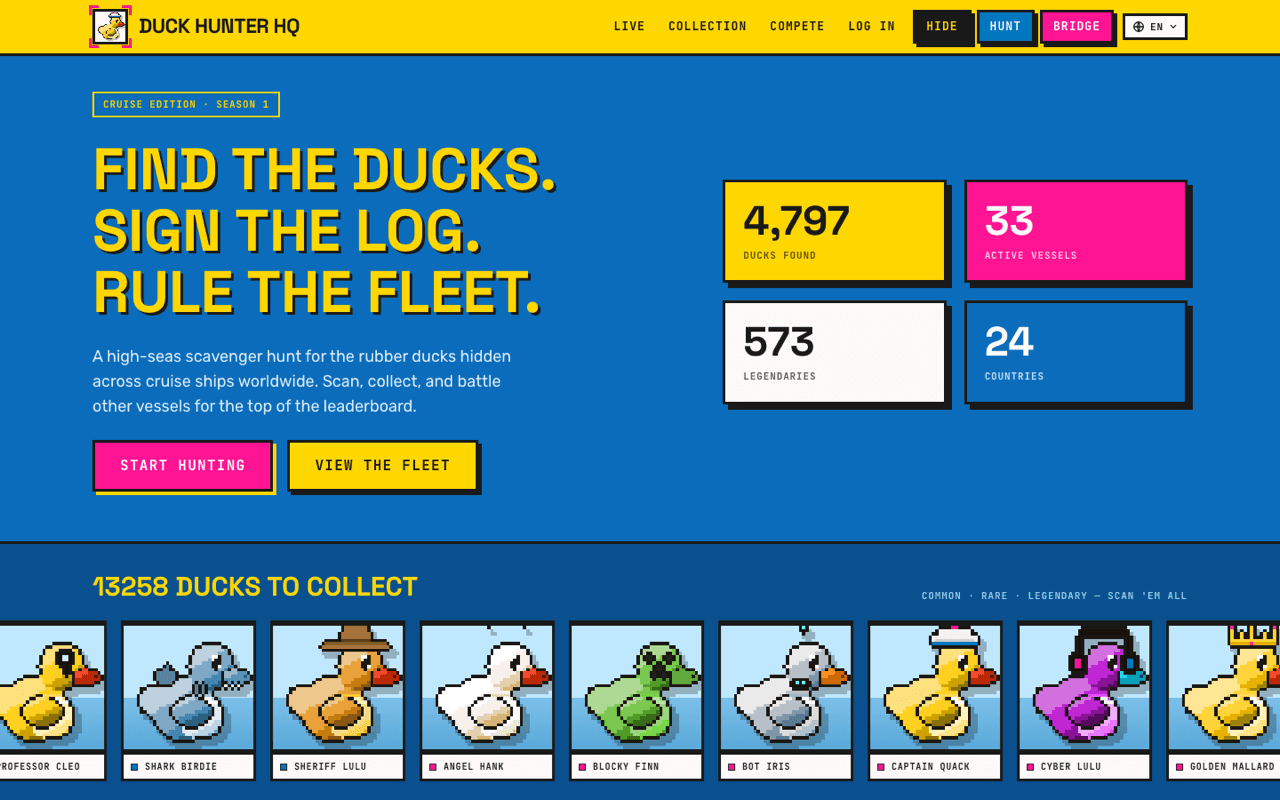
Find the ducks. Sign the log. Rule the fleet.
Scan a rubber duck, sign the log, level up. A QR-powered treasure hunt that turns cruise ships into a global game.
Why I built it
There is this wholesome real-world trend where cruise passengers hide little decorated rubber ducks around the ship for strangers to find. It started in 2018 on the Carnival Breeze and grew into a Facebook community of nearly 300K people, a physical thing with a big community but no digital home. So I built one. You find a duck, scan its QR, see the profile the hider made, and sign the log. From that one loop I layered on collections, RPG leveling, ship-vs-ship leaderboards, a spinning 3D globe, and an arcade mini-game. Pure joy to build.
What it does for people
- Scan-and-sign-the-log core loop: find a duck, scan its QR, see the profile, log the catch, a couple of taps
- Zero-friction anonymous sign-in, so a finder logs a catch instantly and can add their email later without losing history
- RPG progression with XP, auto-levels, rarity tiers, badges, and power stats on every duck
- Ship-vs-ship fleet leaderboards so whole cruises compete against each other
- A duck designer and minting flow where hiders customize and print their own duck's QR card
- Offline Cruise Mode, because ship wifi is terrible. The whole thing keeps working at sea and syncs when you reconnect
Under the hood
- Built on the bleeding edge: Next.js 16 App Router with React 19, using the new proxy.ts convention instead of middleware
- Offline-first architecture using IndexedDB queues. Finds and duck-arming get captured offline and drained when wifi returns, fully unit-tested with fake-indexeddb
- A three-tier Supabase client setup (browser, cookie-bound server with RLS, secret admin) with auth via getClaims rather than getSession
- Postgres does the heavy lifting: generated columns for levels, a materialized fleet_leaderboard view refreshed on a schedule, and RLS enforcing owner-scoped writes
- An anti-cheat integrity layer: non-enumerable opaque duck codes, rate-limiting, burst-flagging, and down-weighting of unconverted anonymous finds
The cool bits
- A genuine physical-meets-digital product. The QR code on a rubber duck is the heartbeat of the whole app
- A 3D interactive globe (react-three-fiber and r3f-globe) plotting where ducks get found around the world in real time
- A bold neo-brutalist pixel design system called Chromatic Quest: sharp corners, hard-offset shadows, no white, retro-arcade energy
- Server-side PDF and print generation for the physical duck cards (pdf-lib and resvg), closing the loop back to the real world
How long it took
Roughly one week of very intense building.
1 week · 289 commits
What I worked through
The biggest challenge was cruise wifi. It is unreliable, so I could not assume a connection for the core experience. That pushed me into a real offline-first architecture with IndexedDB queues that capture finds while offline and sync cleanly when you reconnect. The other tricky part was integrity: because anyone can scan and the app is anonymous-first for zero friction, I had to design against cheating without adding friction, so opaque non-enumerable duck codes, rate-limiting, burst-flagging, and down-weighting finds from anonymous users who never convert.
The full stack
- Next.js 16 (App Router, proxy.ts)
- React 19
- TypeScript
- Tailwind CSS v4
- Supabase (Postgres, Auth, RLS)
- Three.js via react-three-fiber + drei + r3f-globe
- TopoJSON / world-atlas
- Stripe
- @yudiel/react-qr-scanner + qrcode
- IndexedDB (offline sync)
- pdf-lib + resvg (print generation)
- PostHog
- Nodemailer
- Vitest + Testing Library (fake-indexeddb)
- Vercel (cron)